


NEWS新着情報
Events
2024.06.05
Lecture by Prof. Cheng (Ohio State University), a visiting foreign faculty member (designated professor) on June 17th, 2024.
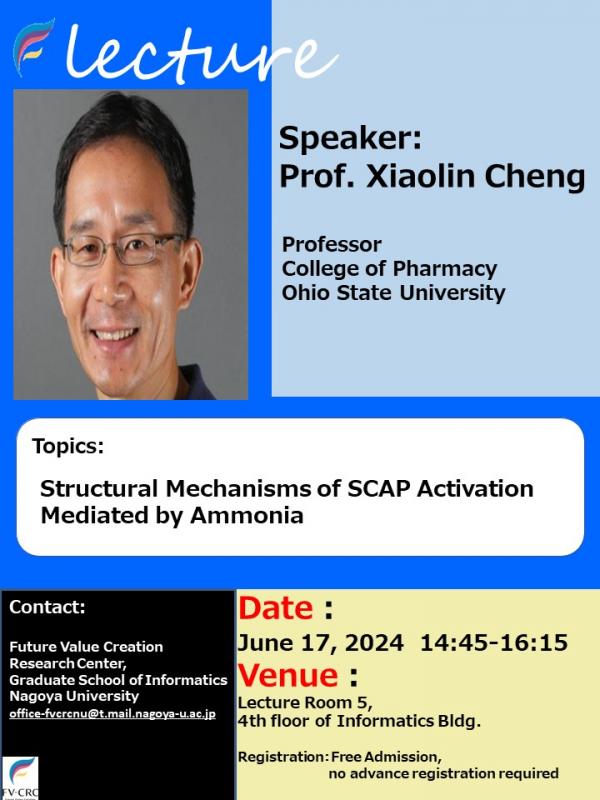 Prof. Xiaolin Cheng (Ohio State University), a visiting foreign faculty member (designated professor) will give a lecture as follows.
Day and time: Monday, June 17, 2024, 2:45pm-4:15pm Venue : Lecture Room 5, 4th floor of Informatics Bldg.
Speaker: Xiaolin Cheng (Professor, College of Pharmacy, Ohio State University)
Topics: Structural Mechanisms of SCAP Activation Mediated by Ammonia
Language: English
Registration: Free Admission, no advance registration required
Abstract:
Cholesterol homeostasis is regulated by the sterol regulatory element-binding protein (SREBP) pathway. with the membrane-embedded SREBP-cleavage-activating protein (SCAP) and insulin-inducible gene protein (Insig)-1/2 acting as sterol sensors. Our previous work revealed the critical role of ammonia in activating the SREBP pathway and identified a potential ammonia binding site formed by D428, S326 and S330 located at the core of the SCAP transmembrane domain1. In this presentation, I will discuss our recent molecular dynamics (MD) simulation study that elucidates the structural mechanisms by which ammonia binding may stimulate SCAP/Insig dissociation and SREBP activation. The SCAP S4 helix is thought to undergo a dynamic interconversion between two conformations: a partially unfolded, bent (inactive) state and a fully intact, straight (active) state during SCAP activation. Our simulations suggest that ammonia acts as an agonist of SCAP, while 25-hydroxycholesterol (25-HC) functions as an antagonist, stabilizing the active and inactive states of SCAP, respectively. Notably, ammonia operates as a hinge connecting the S3 and S6 helices, facilitating their coordinated movement. This hinge is critical for propagating the conformational transition of the S4 helix throughout the SCAP transmembrane domain, inducing alterations in the orientation and structure of the S3 and S6 helices. These structural changes lead to a decreased interaction interface contact area between SCAP and Insig and the repositioned MELADL motif at the membrane surface. Collectively, our findings reveal the intricate interplay between 25-HC and ammonia binding and the conformational transition of the SCAP S4 helix, underscoring the pivotal role of the S4 helix in SCAP activation. 1. Cheng C, Geng F, Li Z, Zhong Y, Wang H, Cheng X, Zhao Y, Mo X, Horbinski C, Duan W, Chakravarti A, Cheng X & Guo D. Ammonia stimulates SCAP/Insig dissociation and SREBP-1 activation to promote lipogenesis and tumour growth. Nature metabolism. 2022 May;4(5):575-88.
Biography:
In the field of drug discovery, researchers have traditionally studied techniques for designing and synthesizing molecules that could be potential therapeutic candidates. However, the trial-and-error approach to drug design has been known to result in an extremely low number of therapeutic candidates reaching the market, with the development process requiring substantial time and cost. Recent advancements in Computer-Aided Drug Design (CADD) have integrated informatics techniques such as data mining and machine learning, and are expected to significantly improve the success rate, development time, and cost of drug discovery. Professor Xiaolin Cheng is one of the internationally renowned researchers in this field.